Monday, June 24, 2013

Gardens of Middleton Place - Charleston, South Carolina

 
One of the Colonial era plantations located north of Charleston proper and also the location for the scene in the movie The Patriot when the Americans provide "fireworks" for the British ball by blowing up the British supply ships.  I would say one of the best times to visit Middleton Place is April while the azaleas are in full bloom in one of the most renowned azalea gardens in the United States! 

Good Night, Charleston - Charleston, South Carolina


Churches of Charles' Towne - Charleston, South Carolina


Pictured clockwise from the top left: Saint Philips Episcopal, French Huguenot, altar and organ of Saint Michael's Episcopal, and below, Trinity United Methodist.

Known as the Holy City and the Mecca of the South, Charleston is the home to numerous congregations of a multitude of religions that make up some of the oldest in North American history!  Since the founding of the Carolina colonies, the area has been religiously tolerant, allowing refugees to practice freely and harmoniously among each other on the peninsula away from the persecution of European tyrants and ecclesiastics.  Of these churches pictured here are some of the most treasured structures of the coastal cityscape of Charleston and to the sundry of  local worshipers.  Beginning with St. Philips Episcopal church, which is home to the oldest congregation of South Carolina since it was established in 1681!  The high reaching tower of St. Philips has marked not just the skyline by day since it's completion in 1850, but also by night as a rear lighthouse.  Standing as the last tower of a range of lighthouses starting at Fort Sumter to guide sea-goers through the harbor, St. Philips is one of two churches to serve as a lighthouse in United States history.  Next is the French Huguenot Protestant church, one of two remaining active in the United States to this day!  Established a few years after refugees arrived in Charleston in 1680's escaping France after the Revocation of the Edict of Nantes which had allowed the Protestants to practice their beliefs within the predominantly catholic France.  The Gothic Revival church today has stood on the same ground that the original 1687 structure had since 1845 and survived the shell-fire and devastation of the American Civil War and numerous hurricanes.  Yes, the Huguenot Church is pink - quite pink!  The following two pictures are from the interior of St. Michael's Episcopal church which happens to be the oldest surviving church building in Charleston!  Completed in 1761, this church has more history than I dare list, but it is noteworthy to mention that President George Washington did attend a few Sunday services looking at the same altar as the one pictured for some historical perspective! 


The structure that the Trinity congregation calls home today was originally built and owned by the Westminster Presbyterians from 1848 until 1926 when the Methodists acquired this sanctuary for their growing congregation.  Surviving the bombardment during the Civil War, the great fire in 1861 and numerous natural disasters, this temple of corinthian columns and beautiful plaster work has been the house of worhip to the local Methodist community for nearly one hundred years!  Also, if you ever do visit this place, note the grand wooden front doors and just how large they are!

Flying the Colors - Fort Sumter, South Carolina


Flying proudly over the point where the first shots of the American Civil War, or as the Southerners like to term it 'War of Northern Aggression', were fired are the colors that have been flown over this historic island fort out in the Charleston Harbor throughout it's long and turbulent history from the early settlement days to today.  I will leave the rest of the fort for your future endeavors!

Moon Landing - Mount Pleasant, South Carolina


I do not know if I am just timing my luck better and more often or I am actually becoming a "photographer"!  I will admit this was an instance of timing and lessons learned from past experiences so it might be a combination of both!  Regardless to that fact, I am glad to have caught this quartet in flight just at the right time with a day moon in sight while walking to Patriots Point park and museum. 

Ships, Stars & the Sea - Mount Pleasant, South Carolina

 
Despite the light pollution mixed in with the high humidity levels, I was surprised that I still captured a few twinkling stars in the sky on an April night!  Another personal favorite of mine is the picture on the left with the Ravenel Bridge lit up behind the bridge of the USS Yorktown moored off of Patriots Point with a hint of the Charleston skyline sending a golden glow up into the night sky.

Walking White Point Gardens - Charleston, South Carolina


The park gained it's name from the early days of European settlement on the peninsula from the sun-bleached shells that washed up on the shores of the meeting point of the Ashley and Cooper rivers.  Throughout the early colonial period, the area was used as a dumping ground for excess building material and a landfill until the early 1800's when peninsula terminus was transformed into a garden park.  Today, the gardens are filled with gnarled boughs of century old trees and commemorations to notable citizens and heroes of Charleston as well as epitaphs to a few famous pirates that were sent to the gallows here.

This was the first place that I took my mother on our Charleston trip when she came down for Easter and I am glad I did!  Along South Battery Street, the north edge of the park, was a wall of chalked full of azalea blossoms on one side and the flower gardens of the Battery mansions on the other!  For anyone visiting the peninsula, I highly recommend going to the Gardens for the sake of directional orientation!  Knowing how direct yourself throughout the Harbor and Old Town really helps when trying to avoid getting lost in the twisting and turning cobbled streets of the Historic District area! 

On the Canal - Augusta, Georgia

 
Not only is the Augusta canal significant to her history as well as our nation's, the canal serves as vital source of life for the citizens and wildlife of the Central Savannah River Area (CSRA).  Winding peacefully next to the wide Savannah River under the shade of the Spanish moss covered trees, floating the canal is a tranquil and relaxing experience to visitors and residents alike!  Speaking of residents, the canal is home to thousands of turtles and I am not exaggerating that number! 

Georgia Guidestones - Elberton, Georgia

 
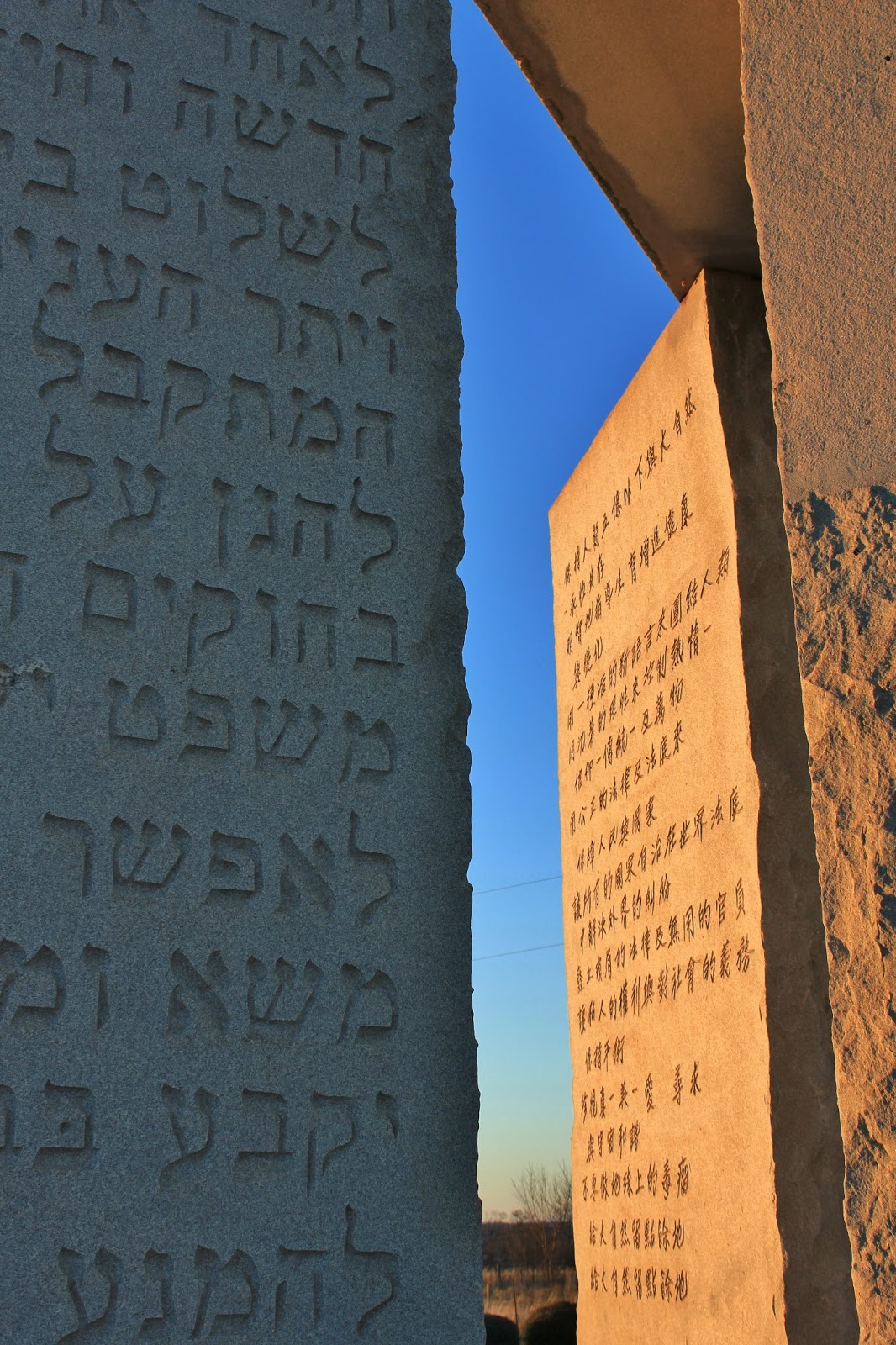
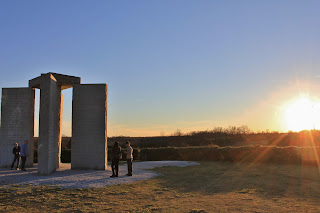
Located in rural northwestern Georgia atop the highest point in Elbert County, the Georgia Guidestones are shrouded with enigma and conspiracy theories by some while others agree with the creators' vision as the guidesstones to the Age of Reason.  The mystery of these stones began from the very beginning as the main man behind the design and funding of the Guidestones has remained anonymous since Elberton Granite Finishing Company received the first draft of plans.  The creator has used the pseudonym of R.C. Christian which has also led conspiracists to believe that these massive slabs of granite are part of a secret social order or "devil worhip" as a local minister at the unveiling termed it.  Nonetheless, these stones are more than mere "guides" written in eight of the world's modern languages, they are also contain remarkably accurate astronomical features within the center stone.
 
The capstone inscription written in four of the world's great ancient languages - Babylonian cuneiform, Egyptian hieroglyphics, Classical Greek, and Sanskrit.  The inscription translates as "Let these be the guidestones to the Age of Reason."  Where the conspiracy theories stem from are from the engravings on the four large "guidestones".  Written in English, Spanish, Russian, Chinese, Hindi, Swahili, Arabic and Hebrew, which are all the more prominent modern languages spoken throughout the world today.  The message of the guidestones reads as follows:
"Maintain humanity under 500,000,000 in perpetual balance with nature.
Guide reproduction wisely — improving fitness and diversity.
Unite humanity with a living new language.
Rule passion — faith — tradition — and all things with tempered reason.
Protect people and nations with fair laws and just courts.
Let all nations rule internally resolving external disputes in a world court.
Avoid petty laws and useless officials.
Balance personal rights with social duties.
Prize truth — beauty — love — seeking harmony with the infinite.
Be not a cancer on the earth — Leave room for nature — Leave room for nature."

 
With the strong meaning behind this somewhat secular message within what I like to term as the "buckle of the Bible Belt", I understand where the mystery and obscurity behind this 'American Stonehenge' comes from!  Being a polyglot myself, I truly appreciate this place not only for it's beautiful rural setting near the Granite Capital of the World (Elberton), but also for the worldly sensation that these stones bring from their engravings.  Centered above is the Arabic word in the noun form for "love" (al-Hub) and I think it had to do with the timing of the sun setting which enhanced the golden color and the crisp shadows on this powerful word that caught my eye.  Another eye catcher was the graffiti in the equinox axis "freedom" just at the exact point with the setting sun made for an amazing shot!  This place is a true Hidden Treasure of Georgia!

Sunday, June 16, 2013

Home of the Double Barreled Cannon - Athens, Georgia


The start of the daily adventure in Athens was somewhat foggy, but made for a unique morning shot while the city lights gave a glowing halo through the heavy air.  As the day went on, the sun shone down on the centerpiece structure of Athens, her city hall and one of the most treasured possessions of history to the city, the Double Barreled Cannon.  Although this double six-pounder never saw wartime action, the trials were described as a success by it's builder John Gilleland, a local dentist, mechanic and builder (quite the handy-man!) after three trials.  Despite those trials being described by viewers as a total failure, such as the first trial "spinning off-center... plowing up an acre of ground, tore up a cornfield" until the chain linking the two balls together broke and then the two projectiles went off in two very different directions.  The third and final trial of the cannon is the one that made my chuckle about when I read the description of the event.  The trial began with the linking chain breaking immediately after the powder had burst the projectiles out of the barrels, one ball tore through a cabin near by and destroyed the chimney while the other ball flung off killing instantly a bystanding cow.  Gilleland still described these a success, which further cements my utterance "...and that is why the South lost the War."  The cannon was born and raised in Athens as it was cast in 1863 in the Athens Foundry and Machine Works at a production cost of $350, probably Confederate dollars.  This is one of the few single cast double barreled cannons remaining in the world and is remarked as one of the best preserved pieces.